(An Initiative by The Better Matter Foundation)
Introduction
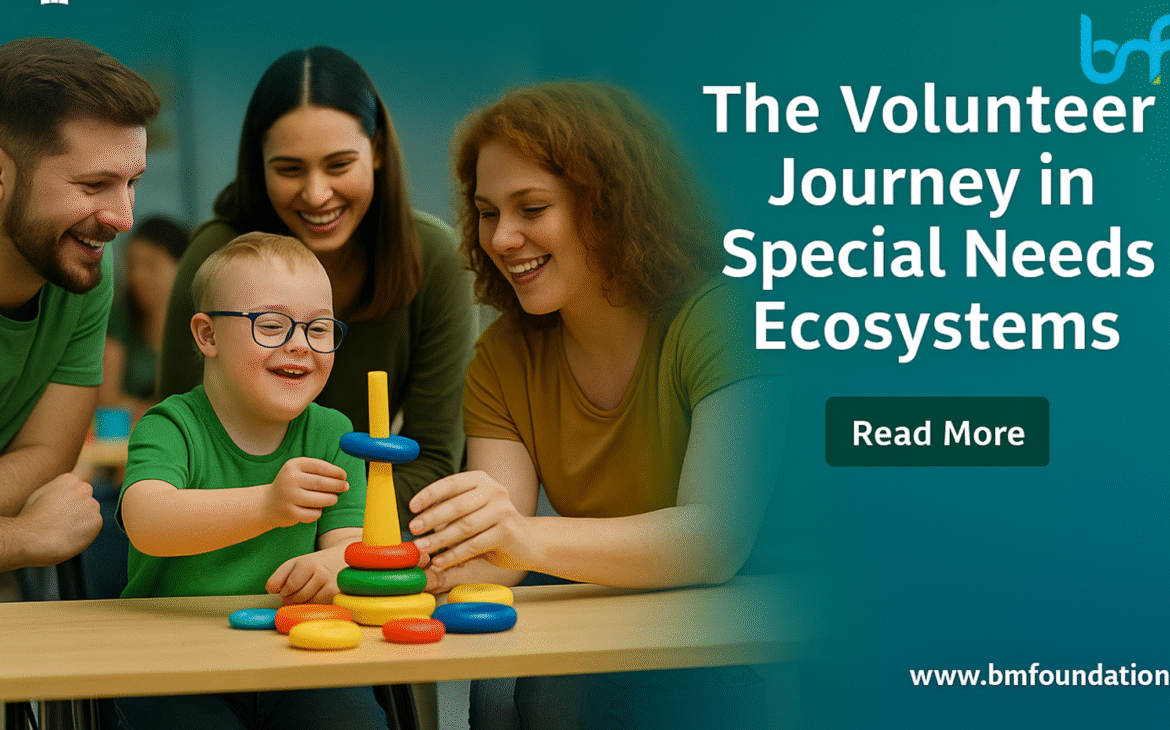
Volunteering is more than service it’s transformation. It changes not only communities but also the people who step forward to help. Nowhere is this transformation more profound than in the world of special needs care.
At The Better Matter Foundation (BMF), we believe that volunteering in special needs ecosystems is not just about giving time it’s about growing empathy, building inclusion, and fostering dignity.
Every volunteer, from students to professionals, becomes a bridge connecting understanding with action, awareness with acceptance, and compassion with change.
This blog explores what the volunteer journey looks like in neurodivergent and special needs spaces the challenges, the lessons, and the life-changing impact of giving, learning, and belonging.
Understanding Special Needs Ecosystems
Before exploring the volunteer’s journey, it’s important to understand what a special needs ecosystem really means.
A special needs ecosystem is not a single institution it’s a web of people, programs, and purpose working together to support neurodivergent individuals and their families.
This includes:
- Children with autism, ADHD, Down syndrome, or learning differences.
- Parents, caregivers, and therapists.
- Educators, volunteers, and social advocates.
- Support networks, community programs, and inclusive organizations.
At BMF, our flagship initiatives Kubic Kids, Our Village, and Health Journeys, come together to create this ecosystem. Volunteers are the lifeblood that keeps it vibrant, empathetic, and evolving.
Why Volunteers Are Vital in Special Needs Spaces
Volunteers bring energy, diversity, and compassion into spaces that thrive on human connection. Their presence amplifies inclusion by doing what systems alone cannot adding heart to structure.
Here’s why they matter:
- They Expand Capacity:
Many special needs centers and schools operate with limited resources. Volunteers help fill crucial gaps from classroom assistance to sensory play, art, or therapy support. - They Normalize Inclusion:
When community members regularly interact with neurodivergent individuals, stigma begins to fade. Volunteers become ambassadors of acceptance. - They Build Emotional Bridges:
Volunteers bring fresh perspectives and open hearts. Their interactions help families feel seen, supported, and valued. - They Inspire Lifelong Change:
Many BMF volunteers go on to pursue careers in special education, psychology, social work, or advocacy, turning empathy into vocation.
At The Better Matter Foundation, we don’t just recruit volunteers, we nurture them to become change catalysts.
The Stages of the Volunteer Journey
Volunteering in special needs ecosystems is a journey of awareness, sensitivity, and growth. At BMF, this journey unfolds in four transformative stages:
Stage 1: Awareness The First Step Toward Empathy
Every volunteer begins with curiosity. Some come looking for purpose, others for perspective, and all find awareness.
BMF introduces volunteers to the fundamentals of neurodiversity and inclusion through structured orientation programs. These sessions cover:
- Understanding different neurotypes (autism, ADHD, learning differences).
- Recognizing strengths instead of focusing on challenges.
- Learning communication techniques (visual cues, sensory needs, gentle interaction).
- Practicing non-judgmental observation.
This stage often reshapes preconceptions. Volunteers learn that neurodivergent children are not “different from the world”, they are a vital part of it.
“After my first session with Kubic Kids, I stopped seeing labels I saw personalities,” shares Arushi, a BMF volunteer.
Stage 2: Engagement Learning Through Connection
Once trained, volunteers move into active engagement within BMF’s programs. This is where learning deepens through direct experience.
In Kubic Kids (Special Needs Education & Care):
- Volunteers assist in classrooms or therapy rooms.
- They help design sensory activities, storytelling sessions, and art projects.
- They interact with children using adaptive communication and emotional validation.
In Our Village (Parent & Community Network):
- Volunteers support parent workshops, sibling support groups, and family engagement events.
- They facilitate inclusive play sessions that bring neurotypical and neurodivergent children together.
In Green Spaces (Environment and Inclusion):
- Volunteers lead eco-therapy activities like gardening, recycling crafts, and community clean-ups with neurodivergent youth.
Here, volunteers begin to unlearn rigid ideas about education and empathy. They witness small victories a child’s smile, a word spoken after months, a parent’s relief and realize that impact is measured in moments, not milestones.
Stage 3: Reflection Growing Through Grace
Volunteering in special needs spaces can be deeply emotional. It requires patience, adaptability, and vulnerability.
That’s why BMF integrates reflection circles and journaling into the volunteer experience. Volunteers share stories, challenges, and insights, often discovering their own emotional growth.
Common reflections include:
- “I realized how communication goes beyond words.”
- “This experience taught me to listen with presence, not pressure.”
- “I learned that inclusion is not about helping others it’s about expanding my own humanity.”
These reflections are where volunteers evolve from helpers to healers, from participants to advocates.
Stage 4: Advocacy, Turning Empathy into Action
The final stage of the volunteer journey is transformation into advocacy.
Many BMF volunteers become long-term mentors, awareness campaigners, or inclusion ambassadors. Some help develop community micro-volunteer circles (as part of our Our Village model), while others create awareness content or lead training sessions.
This is where volunteering ripples outward inspiring workplaces, schools, and families to embrace inclusion.
“I started volunteering to give back, but I ended up gaining clarity about what I want to do for life,” says Sayan, now a speech therapy student after two years with BMF.
The Volunteer Experience: Empathy in Action
Every day at BMF is a living classroom. Volunteers learn lessons that no textbook could ever teach.
Lesson 1: Every Mind Learns Differently
Neurodivergent children show the world that intelligence isn’t one-dimensional. Volunteers witness creativity, humor, and resilience in forms that redefine ability.
Lesson 2: Patience Is a Superpower
Progress is slow but profound. It might take weeks for a child to respond but when they do, that one moment reaffirms why patience is an act of love.
Lesson 3: Inclusion Benefits Everyone
Volunteers often report feeling calmer, kinder, and more grounded. Working in special needs environments builds emotional intelligence, compassion, and community belonging.
Lesson 4: Change Starts Small
Whether it’s helping one parent feel supported or teaching one child a new skill, small acts of care add up. That’s the foundation of the BMF philosophy Real Change, Daily.
How BMF Supports Its Volunteers
The Better Matter Foundation recognizes that volunteering in special needs spaces can be both rewarding and challenging. That’s why our volunteer program includes:
- Pre-service Training – On neurodivergent inclusion, sensory awareness, and emotional safety.
- Supervised Mentorship – Volunteers work alongside special educators and therapists.
- Reflection & Counseling Sessions – For emotional well-being and burnout prevention.
- Certificates & Recognition – Acknowledging meaningful impact.
- Opportunities for Leadership – Volunteers can become community leads or project facilitators.
We nurture volunteers just as we nurture the communities they serve with patience, purpose, and partnership.
The Ripple Effect: Volunteers as Inclusion Ambassadors
The impact of BMF’s volunteers doesn’t end within the walls of a classroom. They carry their learning into:
- Workplaces: promoting inclusive hiring and understanding.
- Universities : starting disability inclusion clubs.
- Families: becoming advocates for acceptance.
- Social Media: sharing stories that normalize neurodivergence.
In doing so, they embody BMF’s vision of Equitable, Resilient Futures for All.
Real Stories of Volunteer Impact
✨ A College Student Turned Educator
Ananya, a psychology major, joined Kubic Kids as a volunteer to fulfill an academic requirement. Months later, she decided to pursue a career in inclusive education. “Volunteering showed me what textbooks couldn’t the joy of meaningful connection,” she says.
The Retired Engineer Who Found Purpose Again
Ravi, a retired professional, began volunteering at BMF’s sensory garden. He now teaches children basic robotics using recycled materials, turning science into sensory exploration.
Global Volunteers, Local Impact
Through BMF’s cross-border collaborations, volunteers from Singapore and Kenya have participated in virtual inclusion workshops proving that empathy travels beyond borders.
The Future of Volunteering in Special Needs Ecosystems
As inclusion becomes a global priority, BMF envisions volunteering as the backbone of social resilience.
We are building a future where:
- Every community has a micro-volunteer circle supporting families of children with special needs.
- Schools and universities integrate inclusive volunteering into their curricula.
- Businesses adopt employee volunteer programs to promote awareness and empathy.
In this future, volunteers are not just helpers they are co-creators of inclusive societies.
Conclusion
The volunteer journey in special needs ecosystems is not just about giving it’s about becoming.
At The Better Matter Foundation, we’ve seen volunteers evolve into advocates, families transform into communities, and compassion grow into collective strength.
When volunteers enter this world, they don’t just change others’ lives they rediscover their own humanity.
Because in the end, inclusion isn’t a project. It’s a practice.
And every volunteer is a heartbeat in that living practice of grace.