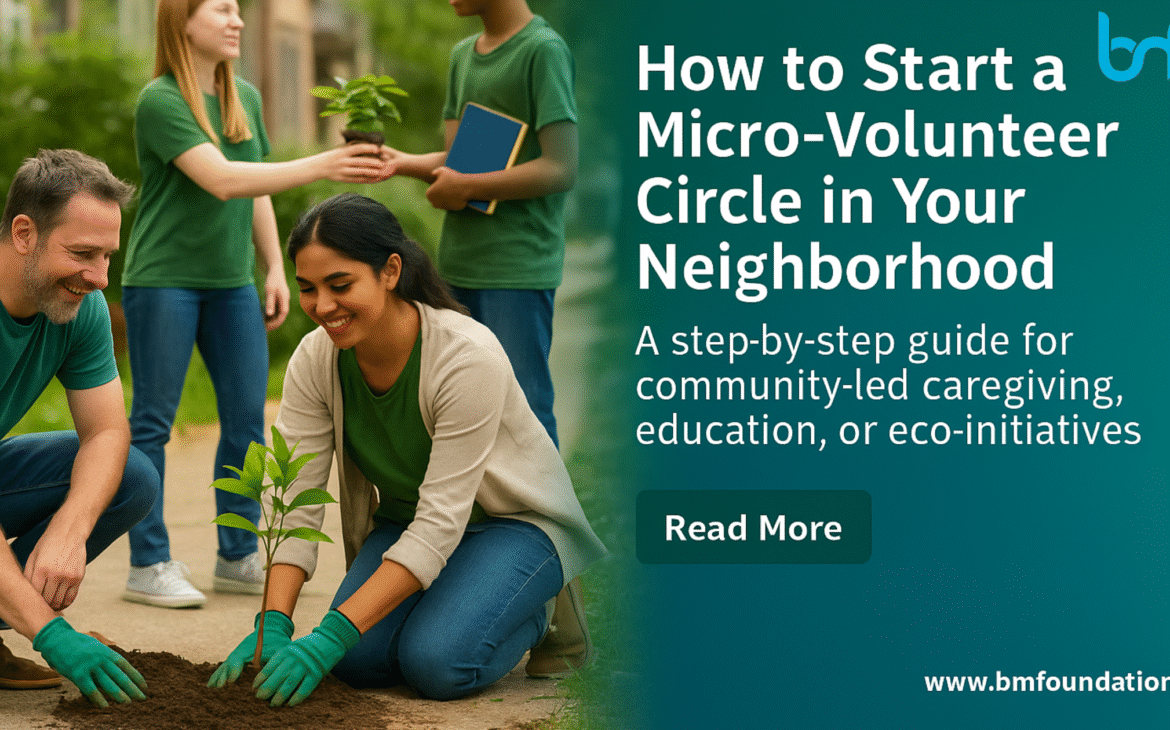
A Step-by-Step Guide for Community-Led Caregiving, Education, or Eco-Initiatives
Introduction
Change doesn’t always begin with grand plans or global campaigns. Often, it starts in the simplest of places a living room conversation, a community park, or a group of neighbors who decide to care a little more.
At The Better Matter Foundation (BMF), we believe that every small act of service creates ripples of transformation. That’s why we’ve built our Micro-Volunteer Circles (MVCs) model, a community-led framework where ordinary people come together to create extraordinary impact in education, caregiving, and environmental action.
Micro-volunteering is about redefining what it means to “do good.” You don’t need an organization, funding, or full-time commitment. All you need is intention, inclusion, and initiative.
This step-by-step guide will show you how to start your own Micro-Volunteer Circle in your neighborhood, one that reflects your community’s needs and values while embodying the BMF principles of empathy, sustainability, and shared responsibility.
What Is a Micro-Volunteer Circle?
A Micro-Volunteer Circle is a small, locally organized group, usually 5 to 15 people, who commit to creating consistent, small-scale social impact within their neighborhood or community.
Unlike large NGOs or formal volunteer programs, micro-circles are:
✅ Flexible: Activities can be done in as little as an hour a week.
✅ Inclusive: People of all ages and abilities can participate.
✅ Local: Focused on real, visible needs within your immediate community.
✅ Collaborative: Built on shared leadership and collective decision-making.
At BMF, micro-volunteering is part of our “Our Village” initiative, where community members act as neighbors helping neighbors. Whether it’s reading to children, cleaning local parks, mentoring students, or supporting neurodivergent families, these small circles nurture connection, inclusion, and action.
“You don’t need to change the whole world, just the world around you.”
Step-by-Step: How to Start a Micro-Volunteer Circle
Step 1: Find Your ‘’Why’—Choose a Purpose That Matters
The first step in starting a Micro-Volunteer Circle is identifying what your community truly needs. Begin by asking:
- What issue touches our lives directly?
- What can we realistically address together with time and heart?
Your circle can focus on one of these BMF-aligned categories:
🌱 Eco-Initiatives – Tree planting, waste segregation, community gardens, or water conservation drives.
🎓 Education & Mentorship – Tutoring children, literacy programs, or supporting neurodivergent learners.
💞 Caregiving & Inclusion – Supporting elderly neighbors, organizing inclusive playdates, or providing respite care for special needs parents.
Choose something local and personal. Purpose fuels participation.
Step 2: Gather a Small, Committed Team
Start with 3 to 5 like-minded people from your building, lane, or residential area. They can be friends, parents, retirees, or students, anyone with a shared desire to contribute.
To begin:
- Host a coffee meet-up or small discussion at home or a local park.
- Share your idea using local WhatsApp or community groups.
- Emphasize that the time commitment is flexible; even one hour per week makes a difference.
Remember: In micro-volunteering, consistency matters more than scale.
BMF recommends having at least:
- 1 Coordinator: To plan activities and communicate.
- 1 Wellness Lead: To ensure inclusivity and emotional well-being of volunteers.
- 1 Documentation Lead: To track activities, photos, and stories (for accountability and sharing).
Step 3: Start Small One Project, One Promise
Begin with a simple, short-term initiative that can show visible results and build confidence.
Here are some easy starter ideas from BMF’s fieldwork:
Education Focus:
- Create a “Parent-Led Reading Circle” for local children every weekend.
- Help neurodivergent kids with creative learning through art and music.
Environment Focus:
- Start a composting corner or a cleanup drive for a local park.
- Conduct a monthly “Green ”Sunday” where families plant one tree together.
Caregiving Focus:
- Cook and deliver meals once a week to elderly or differently-abled neighbors.
- Host sensory play sessions for special needs children in safe spaces.
Keep it achievable. Once the first project succeeds, your circle will naturally grow in energy and trust.
Step 4: Build Partnerships and Leverage Local Resources
You don’t need a big budget to create a big impact. You just need partnerships.
- Schools: Collaborate for joint eco-drives or mentorship programs.
- Local businesses: Request small donations (like stationery, saplings, or snacks).
- Resident associations: Ask for community hall access or event permissions.
- Existing NGOs: Partner for training, workshops, or supplies.
At BMF, we often support micro-circles with toolkits, awareness materials, and mentorship. The goal is to equip communities, not replace them.
Step 5: Make It Inclusive Everyone Has a Role
A truly successful Micro-Volunteer Circle is inclusive, involving people of all backgrounds, ages, and abilities.
Here’s how to ensure inclusion:
- Invite neurodivergent individuals or children to participate meaningfully (e.g., sorting recyclables, painting posters, or watering plants).
- Involve senior citizens as storytellers, teachers, or advisors.
- Encourage children to lead small projects: they bring creativity and enthusiasm.
- Ensure physical accessibility for events and open communication for all participants.
Inclusion is not charity; it’s shared humanity, a value central to every BMF initiative.
Step 6: Create a Rhythm Turn Volunteering into a Ritual
Sporadic volunteering often fades away. To sustain your circle, create a rhythm that fits your community’s lifestyle:
- Weekly 1-hour meetups
- Monthly events (like Eco Sundays or Community Lunches)
- Quarterly reflections to celebrate achievements and plan new goals
Keep it joyful; use music, art, or storytelling to make gatherings engaging.
At BMF, we see that when volunteering becomes a ritual, it strengthens social bonds, builds emotional health, and gives communities a shared sense of belonging.
Step 7: Share Stories and Celebrate Impact
Every act of kindness deserves to be seen, not for fame, but for inspiration.
Document your circle’s activities through photos, notes, and short write-ups. Share updates on social media or within your local WhatsApp groups using hashtags like #OurVillageBMF or #MicroVolunteerCircle.
You can also connect with The Better Matter Foundation for guidance or to feature your circle on our platforms, inspiring more communities to start their own.
“Stories of small change are seeds of big revolutions.”
Step 8: Evolve and Expand from Micro to Movement
Once your circle is stable, consider scaling gradually:
- Create multiple sub-circles for different causes (e.g., Eco, Education, Care).
- Mentor another neighborhood to start their own circle.
- Partner with nearby schools or civic bodies for joint projects.
At BMF, we often see how one Micro-Volunteer Circle can grow into a Community Empowerment Hub, becoming a long-term space for dialogue, inclusion, and local leadership.
When people witness transformation at the grassroots, they realize change isn’t far away; it’s next door.
The BMF Framework Behind Micro-Volunteerism
Our Micro-Volunteer model is rooted in the BMF values of empowerment, inclusivity, sustainability, collaboration, and integrity.
Here’s how each value reflects in every circle:
| BMF Value | In Practice Through MVCs |
|---|---|
| Empowerment | Every individual contributes according to ability and interest. |
| Inclusivity | Neurodivergent and marginalized individuals participate fully. |
| Sustainability | Eco-friendly practices guide every initiative. |
| Collaboration | Circles partner with local schools, families, and groups. |
| Integrity | Transparency and accountability in every activity. |
The goal isn’t perfection, it’s participation. BMF believes that when people come together consistently for the better matter, communities become stronger, more compassionate, and more resilient.
Real Stories of Impact
The Reading Tree Circle, Bhubaneswar
A group of parents and teens started a weekly outdoor reading session for children from nearby low-income neighborhoods. Two years later, the circle has grown into a small mobile library with over 500 books, powered purely by community donations.
The Green Courtyard Initiative, Cuttack
Residents of a housing complex created a micro-circle to convert their waste dumping area into a community garden. Now, they grow vegetables and teach children about composting, merging sustainability with education.
The Compassion Kitchen, Puri
Five mothers of neurodivergent children started cooking and distributing meals once a week to local shelters. Over time, they included their children in planning and packaging, transforming caregiving into inclusion.
These are not projects funded by grants; they are fueled by goodwill and grit.
Conclusion
Starting a micro-volunteer circle is more than organizing a community event; it’s about rekindling the spirit of shared humanity. It’s about neighbors who become friends, children who become changemakers, and ordinary moments that turn into meaningful action.
At The Better Matter Foundation, we believe that when empathy meets structure, volunteering evolves from random acts of kindness into sustained community leadership.
You don’t need to wait for permission to begin; your compassion is enough.
Start small. Start local. Start today.
Because when one circle of care begins, it inspires a hundred more.